Handles are the part of a kitchen people touch hundreds of times a day, and the size is the thing most often got wrong. The number that matters is not the length of the handle but the distance between its screw holes. This guide explains hole centres, how to pick a size for each door and drawer, and how to swap handles without filling old holes.
1. Hole centres: the number that matters
The hole centre (sometimes written as CC or "centres") is the distance from the middle of one screw hole to the middle of the other. It is the measurement you need when you replace a handle, because the new handle has to line up with the holes already drilled in the door.
Most of our bar handles are listed with two numbers, for example 192/200 mm. The first number is the hole centre (192 mm). The second is the overall length of the handle (200 mm). Always shop by the first number.
Hole centres follow the 32 mm system used across European cabinet making, so you will see the same sizes again and again: 96, 128, 160, 192, 256 and 320 mm. Sticking to these sizes means future replacements are easy to find.
2. How to measure an existing handle
- Unscrew the handle and measure between the centres of the two holes in the door, not the outer edges.
- If you cannot remove it, measure from the left edge of one fixing to the left edge of the other. That gives the same figure.
- Round to the nearest standard size. A reading of 190 to 194 mm is a 192 mm handle.
Replacing like for like? Choose the same hole centre and you can use the existing holes with no filling or redrilling.
3. Choosing a size for each door and drawer
A good rule of thumb is a handle around one third of the drawer width. On doors, the size matters less than consistency: most kitchens look best with one hole centre on every door and a longer one on wide drawers and pan drawers.
| Door or drawer width | Suggested hole centre | Our ranges to look at |
|---|---|---|
| Up to 400 mm | 160 to 192 mm, or a knob | VITO 160, BAGIO, NYXA, OCTAVIO, RAY 192 |
| 450 to 600 mm | 192 to 256 mm | IMPERIAL and HEXA 256, any 192 range |
| 700 to 800 mm | 256 to 320 mm | BAGIO, OCTAVIO, NYXA, RAY and IMPERIAL 320 |
| 900 mm and wider | 320 mm, or two handles | Any 320 range |
| Tall larder and wardrobe doors | 320 mm, or a full-length edge profile | PILLAR 1200, HEXA 1200 |
Browse every size in our cabinet handles and cabinet knobs collections, or pick up a matching kitchen handle set if you are doing the whole kitchen.
4. Bar handles, knobs or edge profiles?
- Bar handles such as the GTV BAGIO 192 mm are the easiest to grab and suit almost every kitchen and bedroom.
- Knobs need only one hole and work well on small doors, dressers and wall units where a bar handle would look crowded.
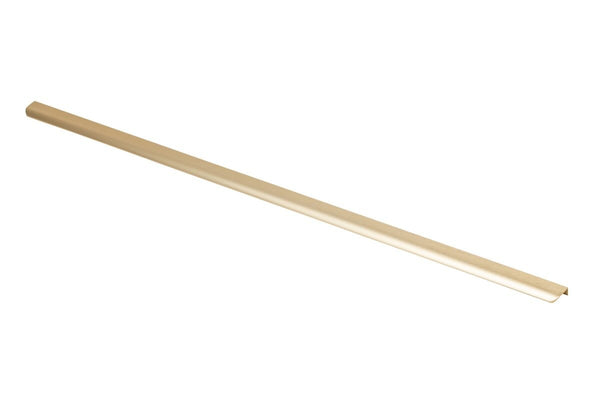
- Edge-mounted profiles such as the GTV HEXA and GTV PILLAR fix to the top or side edge of the door. They give a near-handleless look without the cost of a true handleless rail system.
5. Where to position them
- Drawers: centred horizontally, either in the middle of the drawer front or about a third of the way down on deep pan drawers.
- Base unit doors: vertical, near the top corner on the opening side, around 50 to 80 mm in from the edges.
- Wall unit doors: vertical, near the bottom corner on the opening side.
- Tall doors: vertical, at a comfortable height for the person using it, usually around worktop height.
Make a simple card or MDF template with the two holes marked, and use it for every door so the handles line up across the whole run.
6. Screws and door thickness
Most bar handles fix with M4 machine screws through the back of the door. The screw needs to be long enough to pass through the door and engage the handle by several millimetres. For a standard 18 mm door, that usually means a screw around 25 mm long. Thicker doors or doors with a moulded back panel may need longer screws.
Drill from the front with a sharp 5 mm bit and a block clamped behind the door to stop the back from splintering.
Quick checklist
- Measure hole centres, not overall length.
- Stick to standard sizes: 160, 192, 256, 320 mm.
- One size for doors, a longer size for wide drawers.
- Use a drilling template so every handle lines up.
- Check screw length against your door thickness.
Not sure which size suits your kitchen? Message us with a photo and your door widths and we will suggest a size and finish. You can also try handles on a door with our handle visualiser.